
Do Police Need a Warrant to Search a Hotel Room?

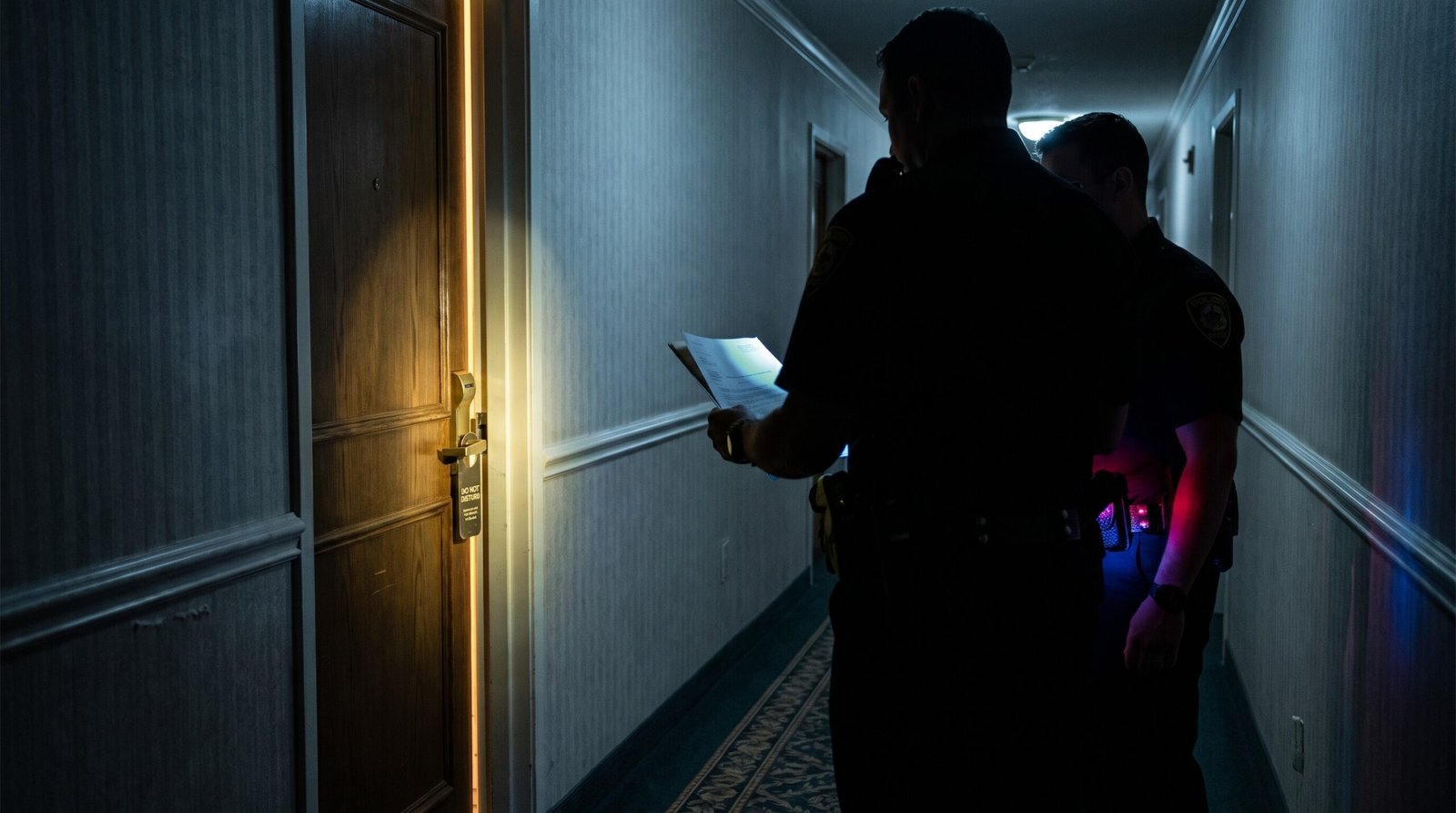
If you’re renting a hotel room, checked in, and paying for your stay, that room belongs to you for the time being — at least in the eyes of the law. Police generally cannot search it without a warrant, even though you don’t own the building. Here’s how that works, and where the exceptions come in.
Why a Rented Room Gets the Same Protection as a Home
It might feel strange that a room you’re only borrowing for a night or two gets strong legal protection. But courts don’t look at who owns the walls — they look at who has a reasonable right to privacy inside them. While you’re a paying, checked-in guest, that room is treated as your temporary home. The hotel manager holding a master key doesn’t change that, any more than a landlord holding a spare key to your apartment would let the landlord invite police in to search your things.
The Case That Settled It: Stoner v. California (1964)
Decades ago, this wasn’t fully settled law. That changed with Stoner v. California, a U.S. Supreme Court case from 1964. Police were investigating an armed robbery and tracked a suspect to a hotel. Without a warrant, officers asked the front desk clerk for permission to search the suspect’s room — and the clerk agreed to let them in.
The Supreme Court ruled that this search was unconstitutional. A hotel employee doesn’t have the authority to hand over a paying guest’s privacy just because they hold a key to the room. The Court made clear that a guest’s right to privacy doesn’t disappear just because they’re staying somewhere temporarily instead of at home.
That case is still the foundation of hotel privacy law today.
When Police DO Need a Warrant
- While you’re checked in and your stay is still valid
- Even if hotel staff offers to let them in
- Even if you’re not currently in the room at that moment
- Even if the hotel suspects rule-breaking (like extra guests or smoking)
In all of these situations, officers generally need to go to a judge, show probable cause, and get a signed warrant before searching your belongings.
When Police DON’T Need a Warrant
| Situation | Warrant Needed? | Why |
|---|---|---|
| You personally give consent | No | You’ve voluntarily waived your own privacy protection |
| A genuine emergency (someone screaming for help, smoke, gunfire) | No | Courts allow immediate entry when there’s an urgent safety risk |
| Your checkout time has passed and you haven’t renewed or paid for more time | No | Courts have found your expectation of privacy ends once your rental period is over |
| Officers already hold a valid search warrant | N/A | This is the lawful process itself |
What Happens the Moment Checkout Time Passes?
This is where a lot of people get caught off guard, and it’s an area courts have been actively refining. In a 2026 case, United States v. Mendoza, the Third Circuit Court of Appeals ruled that a guest no longer had a reasonable expectation of privacy in their hotel room just five hours after their checkout time had passed. Once that happens, the hotel can treat the room as its own property again — which can include letting staff, or police, inside.
The takeaway: your privacy protection isn’t permanent. It’s tied to your rental period. Overstaying without checking out again or paying for another night can end your legal protection surprisingly fast.
Does a Warrant Let Police Search Every Corner of the Room?
Once officers do have a valid warrant, how far can they go? A 2026 case out of New Jersey, United States v. Evans, gives a clear real-world example. Officers had a warrant to search a hotel room for firearm-related evidence. While inside, a detective noticed a damaged ceiling tile resting on the bed. He pressed on it, and a gun magazine fell out — followed by bags of drugs and cash hidden above the ceiling.
The guest argued the officers went beyond what the warrant allowed. The court disagreed. The reasoning was simple: a warrant to search for a firearm and its parts covers any space in the room where those items could reasonably fit — including the space above a ceiling tile. In other words, a valid warrant isn’t limited to drawers and suitcases. It reasonably extends anywhere the listed evidence could be hidden.
Can Hotel Staff Search Your Room on Their Own?
Housekeeping and maintenance staff can enter your room for normal business reasons, like cleaning or fixing something you reported. If they happen to notice something illegal in plain sight while doing their job, and they report it to police, that’s generally treated differently than a police-directed search — since it wasn’t the government doing the searching. But hotel staff cannot invite police in to dig through your belongings on their own authority while you’re still a valid, paying guest.
What To Do If Police Show Up at Your Door
- You can ask if they have a warrant. You’re entitled to see it.
- You can decline a search if they don’t have one. Saying “I don’t consent to a search” is a legal, calm response.
- Don’t physically block officers if they say it’s an emergency — you can still verbally state you don’t consent, and challenge it later through a lawyer if needed.
- Keep track of your checkout time. If you need more time in the room, renew it before it expires.
At a Glance
| Question | Answer |
|---|---|
| Do police need a warrant to search my hotel room? | Yes, while you’re a valid, checked-in guest |
| Can hotel staff let police in without my consent? | No, not while your stay is still active |
| Does my privacy protection last after checkout time? | No — it can end within hours, per recent court rulings |
| Can a warrant cover hidden spots like ceilings? | Yes, if the listed evidence could reasonably be there |
| Can I say no to a search? | Yes, unless there’s a genuine emergency |
Hotel rooms come with real legal protection, but that protection is tied closely to your rental period — not the building itself. Knowing when that protection starts and ends can make a big difference if you’re ever in this situation.