
What Are Your Rights During a DUI Checkpoint?

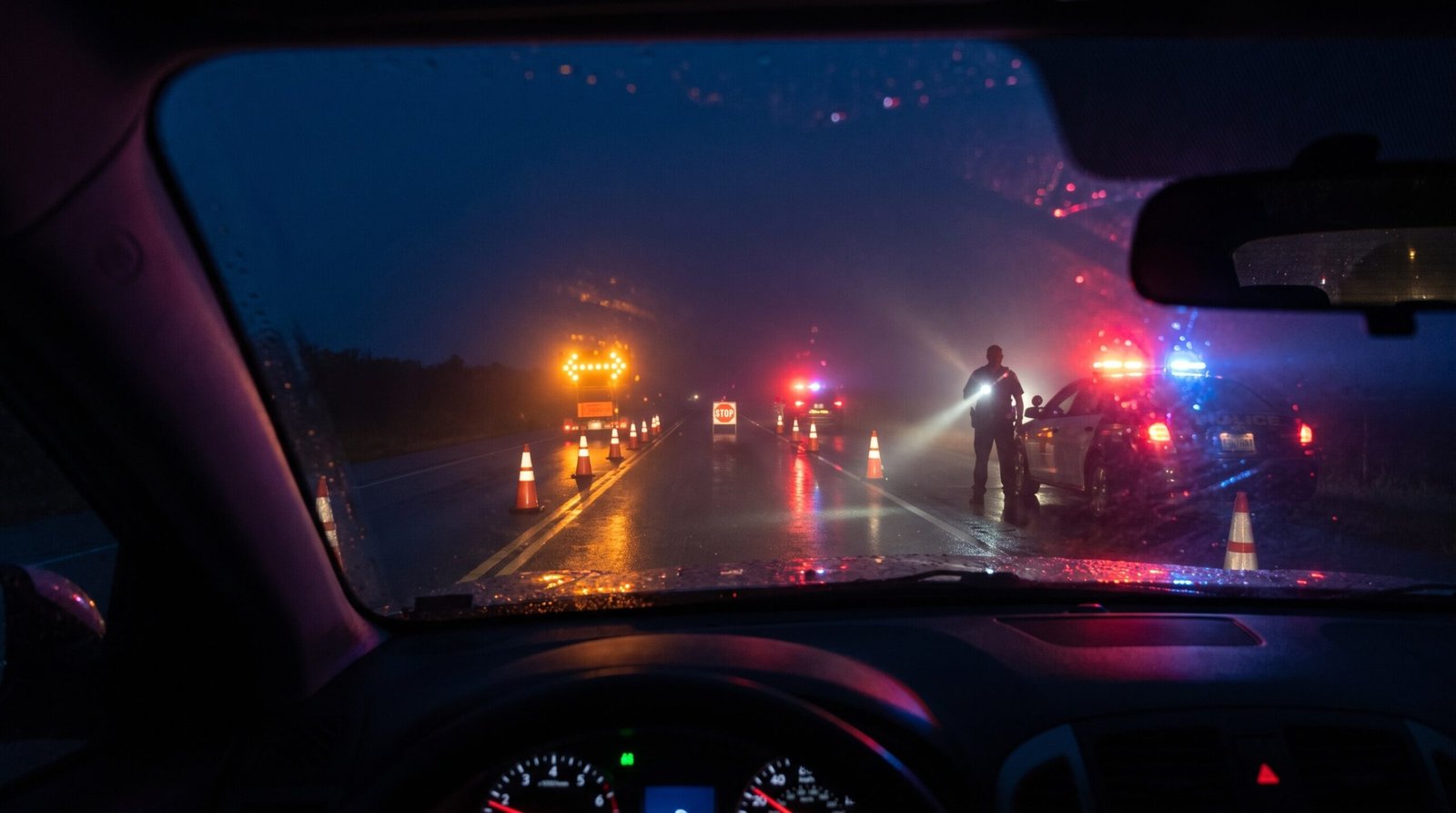
DUI checkpoints (also called sobriety checkpoints) are legal under federal law, but what happens once you’re stopped is governed by a specific set of rules — and there are things you can refuse to do, even at a checkpoint. Here’s a full breakdown.
Why Checkpoints Are Allowed At All
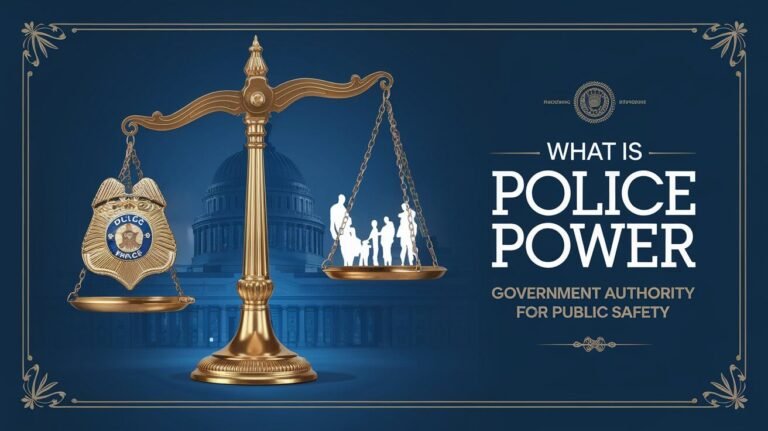
Normally, police need at least reasonable suspicion to pull someone over. A checkpoint is different — cars are stopped without any suspicion of wrongdoing at all, based purely on a predetermined pattern (like every third car). That would normally raise a Fourth Amendment problem.
This question went to the U.S. Supreme Court in Michigan Department of State Police v. Sitz (1990). The Court ruled that the minor inconvenience of a brief checkpoint stop is outweighed by the public safety benefit of catching impaired drivers, so sobriety checkpoints don’t violate the Fourth Amendment — as long as they’re run fairly and consistently.
Here’s the twist: even though the Supreme Court sided with Michigan in that case, Michigan’s own state supreme court later reviewed the same checkpoint program under the state constitution and ruled it wasn’t allowed there. That’s why checkpoint rules aren’t the same everywhere — states are free to offer more protection than the federal minimum.
Not Every State Uses Checkpoints
About 38 states plus Washington, D.C. use sobriety checkpoints. A commonly cited group of 12 states don’t, either because state courts ruled they violate the state constitution, or lawmakers never authorized them:
| States That Don’t Use DUI Checkpoints |
|---|
| Alaska |
| Idaho |
| Iowa |
| Michigan |
| Minnesota |
| Montana |
| Oregon |
| Rhode Island |
| Texas |
| Washington |
| Wisconsin |
| Wyoming |
A few states take a middle path: New Hampshire, South Carolina, and Utah allow checkpoints, but only after a judge signs off on the plan in advance. Since state rules shift occasionally, it’s worth checking your own state’s current status if you want to be sure.
What You Must Do at a Checkpoint
- Stop your vehicle when directed
- Provide your driver’s license, registration, and proof of insurance
- Roll your window down enough to communicate and hand over documents
What You Can Legally Refuse
| You Can Refuse | What Happens If You Refuse |
|---|---|
| Answering questions like “Have you been drinking?” | Nothing — this is protected by your Fifth Amendment right to stay silent |
| Field sobriety tests (walking a line, standing on one leg, etc.) | These are voluntary in most states; refusing them alone isn’t a crime |
| The roadside breath test (preliminary breath test) | In most states, this specific test is voluntary and different from the official chemical test |
| A vehicle search without consent or a warrant | Officers generally need probable cause or your consent to search your car |
The Test You Usually Can’t Refuse: Implied Consent
Here’s where it gets more serious. If you’re actually arrested for DUI, most states have an implied consent law — meaning that by having a driver’s license, you’ve already agreed to take an official chemical test (breath or blood) if arrested. Refusing that specific test after an arrest typically triggers an automatic license suspension, even if you’re never convicted of DUI.
The key difference to remember:
- Roadside preliminary test, before arrest → usually voluntary, few or no direct penalties for declining
- Official chemical test, after a lawful arrest → usually mandatory under implied consent laws, with automatic penalties for refusal
Can You Just Turn Around and Avoid the Checkpoint?
Yes, in most cases. Courts have generally held that legally turning onto another street, making a legal U-turn, or taking an earlier exit to avoid a checkpoint isn’t by itself a reason for police to stop you. The key word is “legally” — if you make an illegal turn, run a stop sign, or commit any other traffic violation while avoiding the checkpoint, that violation alone gives officers a valid reason to pull you over.
What Makes a Checkpoint Legal in the First Place
Even in states that allow checkpoints, officers can’t just set one up anywhere on a whim. Courts generally expect:
- Advance public notice of the general time and location
- A neutral, fixed pattern for choosing which cars to stop (not officer discretion)
- Supervisory approval of the checkpoint’s location and procedures ahead of time
- Minimal delay for each driver passing through
- Reasonable safety measures, like proper lighting, signage, and warning of the checkpoint ahead
If a checkpoint skips these safeguards, a defense attorney can sometimes get evidence from that stop thrown out.
At a Glance
| Question | Answer |
|---|---|
| Are DUI checkpoints legal? | Yes, under federal law, but not every state uses them |
| Do I have to answer questions about drinking? | No |
| Do I have to do field sobriety tests? | No, these are voluntary in most states |
| Do I have to take the official chemical test after arrest? | Usually yes, under implied consent laws — refusing has automatic penalties |
| Can I turn around before reaching the checkpoint? | Yes, as long as you don’t break any traffic laws doing so |
Checkpoints exist to catch impaired driving, but you still keep several rights the moment you pull up to one. Knowing the difference between what you must do and what’s actually optional can make a real difference if you’re ever stopped at one.


One Comment