Can AI-Manipulated Video Be Used as Evidence in Court?

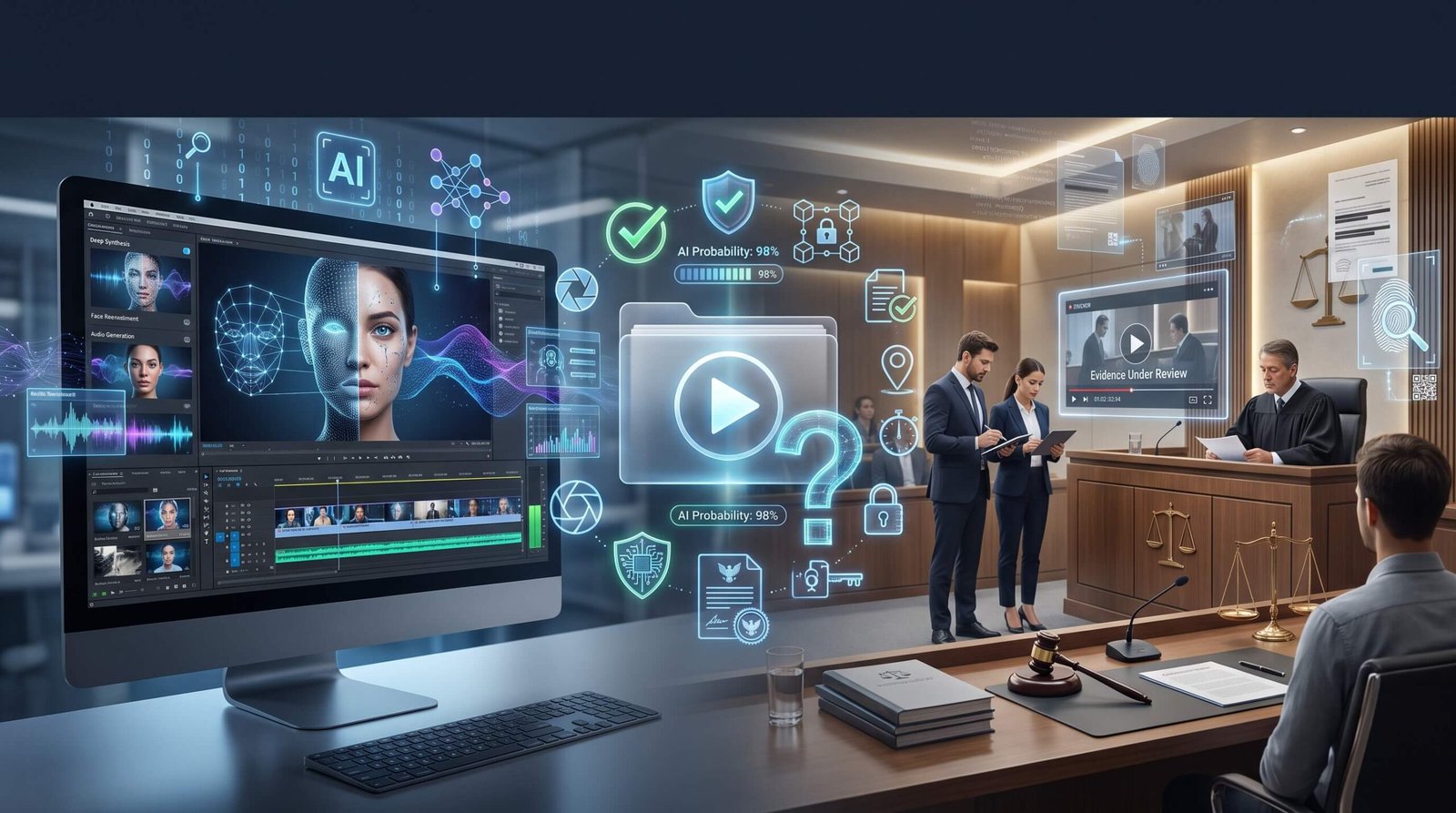
Courts are facing a strange, two-sided problem at the same time: fabricated AI video is getting good enough to slip past traditional evidence checks, while defendants are increasingly claiming that real, genuine footage is secretly fake. Both problems are already showing up in real cases, and the legal system is still catching up to either one.
The Rule Everyone’s Working From Right Now
As of today, there’s no special federal rule just for AI-generated or AI-manipulated evidence. Video is still evaluated the same way it always has been, under Federal Rule of Evidence 901: whoever wants to introduce a video only has to show enough for a reasonable jury to conclude it’s more likely than not authentic. That’s a relatively low bar, and it was written decades before generative AI existed.
Once evidence clears that bar, a second tool comes into play. Rule 403 lets a judge exclude evidence anyway if its value is substantially outweighed by the risk of unfair prejudice or misleading the jury — a tool judges have started leaning on more heavily specifically because AI-altered footage can be so convincing that even calling it into question in front of a jury can distort how they see everything else in the case.
Why the Old Rules Are Struggling to Keep Up
Traditional authentication methods, like a witness confirming “yes, that’s what happened” or checking a file’s metadata, were built for a world where faking a video took real skill and left detectable traces. Generative AI breaks both of those assumptions. Detection tools built to catch AI-generated content have themselves proven unreliable, and studies suggest even trained observers aren’t much better than random chance at spotting a well-made fake. That’s created what researchers now call a cat-and-mouse problem: as fast as detection improves, generation improves faster.
Two New Federal Rules Are on the Way — Just Not Yet
Recognizing the gap, the federal Judicial Conference’s Advisory Committee on Evidence Rules has spent the past year working on new rules specifically for this problem:
- A possible amendment to Rule 901 would add a specific process for challenging suspected deepfakes: the challenger would first have to show a jury could reasonably find the evidence was AI-altered, and if that bar is met, the party offering the evidence would then have to prove it’s authentic to a higher standard than normal. As of mid-2026, the committee has leaned toward a “wait-and-see” approach on this specific change, preferring to let a separate new rule handle the problem instead.
- A new Rule 707, covering “machine-generated evidence,” would apply the same reliability standards used for expert witness testimony to AI-generated evidence offered without an expert. Public comment on this rule closed in February 2026, with a committee vote expected in May 2026.
Even supporters of Rule 707 acknowledge its limits — it only applies to evidence a party admits was created using AI, like an AI-generated accident reconstruction. It does nothing for a deepfake someone tries to sneak in while claiming it’s simply real footage. And even if approved on schedule, the earliest realistic effective date for either rule is December 1, 2027, following review by the Judicial Conference, the Supreme Court, and Congress.
A few states aren’t waiting. Louisiana has already put its own AI-evidence verification framework into state law, and other states have legislation in progress.
What’s Already Happened in Real Courtrooms
| Case | What Happened | What It Shows |
|---|---|---|
| Alameda County, CA (Sept. 2025) | A civil case was dismissed after a judge found videotaped witness testimony had been deliberately fabricated using AI | Courts will act decisively once fabrication is actually proven |
| Washington v. Puloka | A court excluded AI-enhanced video evidence for lacking sufficient reliability | Enhancement or alteration by AI can sink evidence even without accusations of deception |
| Huang v. Tesla (CA state court) | A judge rejected a challenge to video evidence based only on the vague claim it “could” be a deepfake | Simply suggesting something might be fake, without real supporting evidence, isn’t enough to get it thrown out |
That last case matters just as much as the first two. It shows courts are trying to hold a middle line — taking real fabrication seriously while refusing to let every piece of damaging video get waved away with a bare accusation.
The “Liar’s Dividend” Problem
This is the flip side researchers are increasingly worried about. As the public becomes more aware that video can be faked, it becomes easier for someone caught on genuine, damaging footage to simply claim it’s an AI fabrication — even with zero proof. Legal scholars call this the liar’s dividend: the benefit a wrongdoer gets purely from public uncertainty about what’s real, regardless of whether their specific claim is true. Some defendants floated exactly this argument after the January 6, 2021 Capitol riot, suggesting footage of their own actions might be fabricated. One evidence law scholar working with the federal committee has said she expects courts to run into serious liar’s-dividend problems even sooner than they run into convincing deepfakes themselves.
How Prosecutors and Departments Are Protecting Their Evidence Now
Since new rules are still years away, agencies handling video evidence, including police departments, are increasingly expected to build a stronger authenticity record from the moment footage is captured, rather than trying to prove it after a challenge arises. Common practices now include:
- Generating a cryptographic hash (a unique digital fingerprint) for footage as soon as it’s captured, so any later alteration can be detected
- Keeping a complete, tamper-evident chain-of-custody record from capture to courtroom
- Preserving all original metadata rather than stripping it during file transfers or format conversions
- Being prepared to call a witness or expert who can speak to exactly how and when footage was captured and stored
Courts have made clear that even genuine footage can be excluded over sloppy handling — gaps in a chain-of-custody record or missing metadata can sink authentic evidence just as easily as a real deepfake accusation can.
Where This Leaves Things Today
Right now, AI-manipulated video can absolutely be challenged and kept out of court, but there’s no dedicated federal rule doing that work yet — judges are stretching existing tools built for a different era to handle a problem they weren’t designed for. Real fabricated evidence has already gotten a case thrown out, real courts have already rejected bare “it might be fake” claims, and new federal rules are still working their way through a process that won’t finish before late 2027 at the earliest. Until then, expect this to keep playing out case by case, judge by judge, with the strength of an agency’s evidence-handling practices mattering just as much as the footage itself.