What Is a No-Knock Warrant?

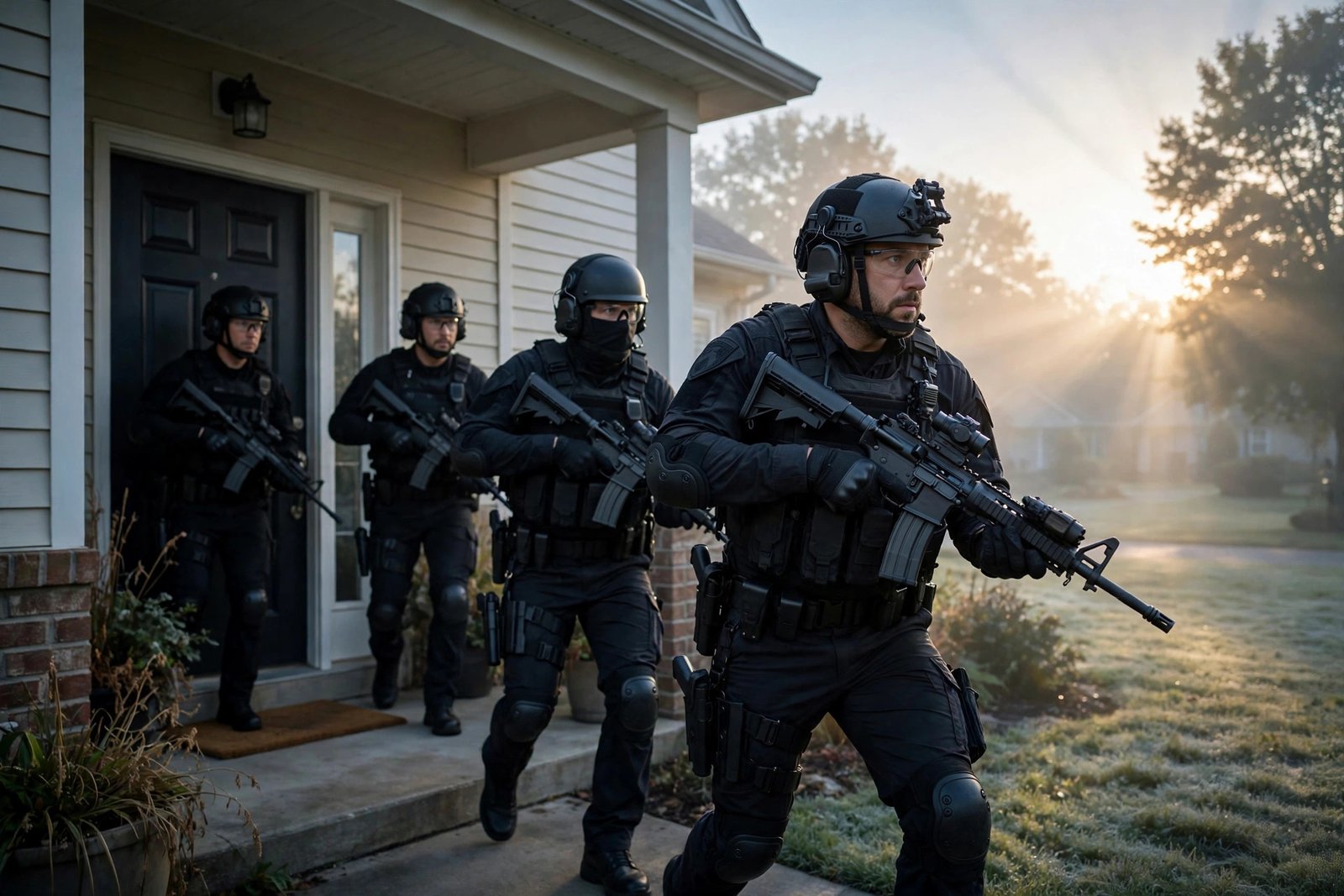
A no-knock warrant is a court order that authorizes police to enter a property — usually a home — without first knocking and announcing their presence. Normally, officers executing a search warrant must knock, identify themselves, and wait a reasonable time before forcing entry. A no-knock warrant removes that requirement, allowing officers to enter suddenly and without warning.
These warrants are among the most controversial tools in American policing, and their use has been sharply restricted in many states in recent years.
The Knock-and-Announce Rule
The starting point is the traditional “knock-and-announce” rule, which has deep roots in American law:
- Before entering a home to execute a warrant, officers must generally knock, announce their identity and purpose, and wait a reasonable amount of time (often interpreted as 15–20 seconds or more).
- The U.S. Supreme Court recognized this principle as part of the Fourth Amendment’s protection against unreasonable searches in Wilson v. Arkansas (1995).
- The rule protects three interests: reducing the risk of violence from startled occupants, protecting property from unnecessary destruction, and preserving residents’ dignity and privacy.
- However, the Court also held that the rule is not absolute — officers may skip the announcement when they have reasonable suspicion that knocking would be dangerous, futile, or would allow evidence to be destroyed.
What Makes a Warrant “No-Knock”?
A no-knock warrant is issued by a judge in advance, with explicit permission to enter without announcing. For a judge to grant one, officers must typically show:
- Danger to officers or others: credible reason to believe announcing would put lives at risk (for example, a suspect known to be armed and violent).
- Risk of evidence destruction: reason to believe the suspect would destroy drugs, weapons, or documents if warned.
- Risk of escape: reason to believe the suspect would flee during the announcement delay.
The application must explain the specific facts supporting these concerns — a judge is supposed to weigh them before signing. In practice, critics argue that judges have approved no-knock warrants too routinely, sometimes based on boilerplate language rather than genuine case-specific danger.
No-knock entries are most associated with drug investigations, where the dual concerns of armed suspects and easily destroyed evidence are most often cited.
Breonna Taylor and the Push for Reform
No-knock warrants entered the national spotlight in March 2020, when Louisville, Kentucky police officers executing a no-knock search warrant at the apartment of Breonna Taylor — a 26-year-old emergency medical technician — shot and killed her during the raid. Taylor was not the target of the investigation and had no criminal record.
The case triggered a nationwide reckoning over the tactic:
- Louisville passed “Breonna’s Law” in June 2020, banning no-knock warrants within the city.
- The case became a central symbol in the broader 2020 protests over policing.
- Investigations revealed concerns about how the warrant was obtained, including questions about the evidence presented to the judge.
- Several officers involved faced criminal charges in subsequent federal and state proceedings.
States That Have Banned or Restricted No-Knock Warrants
Since 2020, many states and cities have limited or eliminated no-knock warrants:
- Outright bans: Virginia became the first state to ban no-knock warrants entirely (2020). Oregon followed with its own ban (2021).
- Sharp restrictions: Connecticut, Massachusetts, and Illinois passed laws significantly limiting when no-knock warrants can be issued — for example, restricting them to cases involving imminent threats to life or requiring higher-level approval.
- Local bans: Dozens of cities, including Louisville, Indianapolis, and others, have banned the practice through local ordinances.
- Federal limits: In 2021, the U.S. Department of Justice restricted federal agents’ use of no-knock entries, limiting them to situations where there is an imminent threat of physical violence.
Laws in this area are changing quickly. If this issue matters to you, check your current state and local laws, since reforms continue to be proposed and enacted.
Why No-Knock Warrants Remain Controversial
Supporters — mostly in law enforcement — argue the tactic is sometimes necessary:
- Announcing can give armed suspects time to arm themselves, endangering officers.
- In drug cases, evidence can be flushed or destroyed in seconds.
- When properly justified and approved by a judge, they say, no-knock entries are a legitimate tool for high-risk situations.
Critics — including civil liberties groups, many lawmakers, and policing reform advocates — argue:
- Sudden, unannounced entries at night terrify occupants, who may reasonably believe they are being attacked by intruders and respond with force — creating deadly confrontations that the warrant was supposed to prevent.
- Wrong-address raids have resulted in innocent people being harmed or killed.
- The tactic has disproportionately affected communities of color.
- Less dangerous alternatives exist, such as arresting suspects outside the home or executing warrants during daylight hours.
Key Takeaways
- A no-knock warrant lets police enter without knocking or announcing, but it must be approved by a judge in advance.
- The knock-and-announce rule is the constitutional default; no-knock entry is the exception.
- Judges are supposed to require specific evidence of danger, evidence destruction, or escape risk.
- Since the killing of Breonna Taylor in 2020, multiple states and cities have banned or restricted the practice.
- Federal agents now face strict limits on no-knock entries.
Frequently Asked Questions
Are no-knock warrants legal? Yes, at the federal level and in many states they remain legal when a judge authorizes them based on the required showing. But a growing number of states and cities have banned or restricted them.
What’s the difference between a no-knock warrant and a “quick-knock” entry? A “quick-knock” (or “knock-and-announce with minimal delay”) is when officers announce but wait only a few seconds before entering. Courts have sometimes upheld very short waits, which critics say functions like a no-knock raid. A true no-knock warrant involves no announcement at all.
Can police do a no-knock raid without a warrant? Generally, warrantless entry into a home is presumed unreasonable under the Fourth Amendment. Exceptions exist (such as hot pursuit or genuine emergencies), but a planned no-knock entry for a search normally requires a judge’s authorization.
Do officers have to wear body cameras during no-knock raids? This depends on department policy and state law, not a single national rule. Many departments now require body cameras during warrant service, and some reform laws have made this mandatory.
What should I do if police enter my home unannounced? Do not resist physically — sudden resistance during a raid can be deadly. Comply in the moment, remember details, and contact a lawyer afterward if you believe your rights were violated.
Have no-knock warrants been banned nationwide? No. There is no federal ban applying to state and local police. Restrictions so far have come from individual states, cities, and federal agency policy.
This article is for general information only and is not legal advice.