Can Police Use Drone Footage as Evidence in Court?

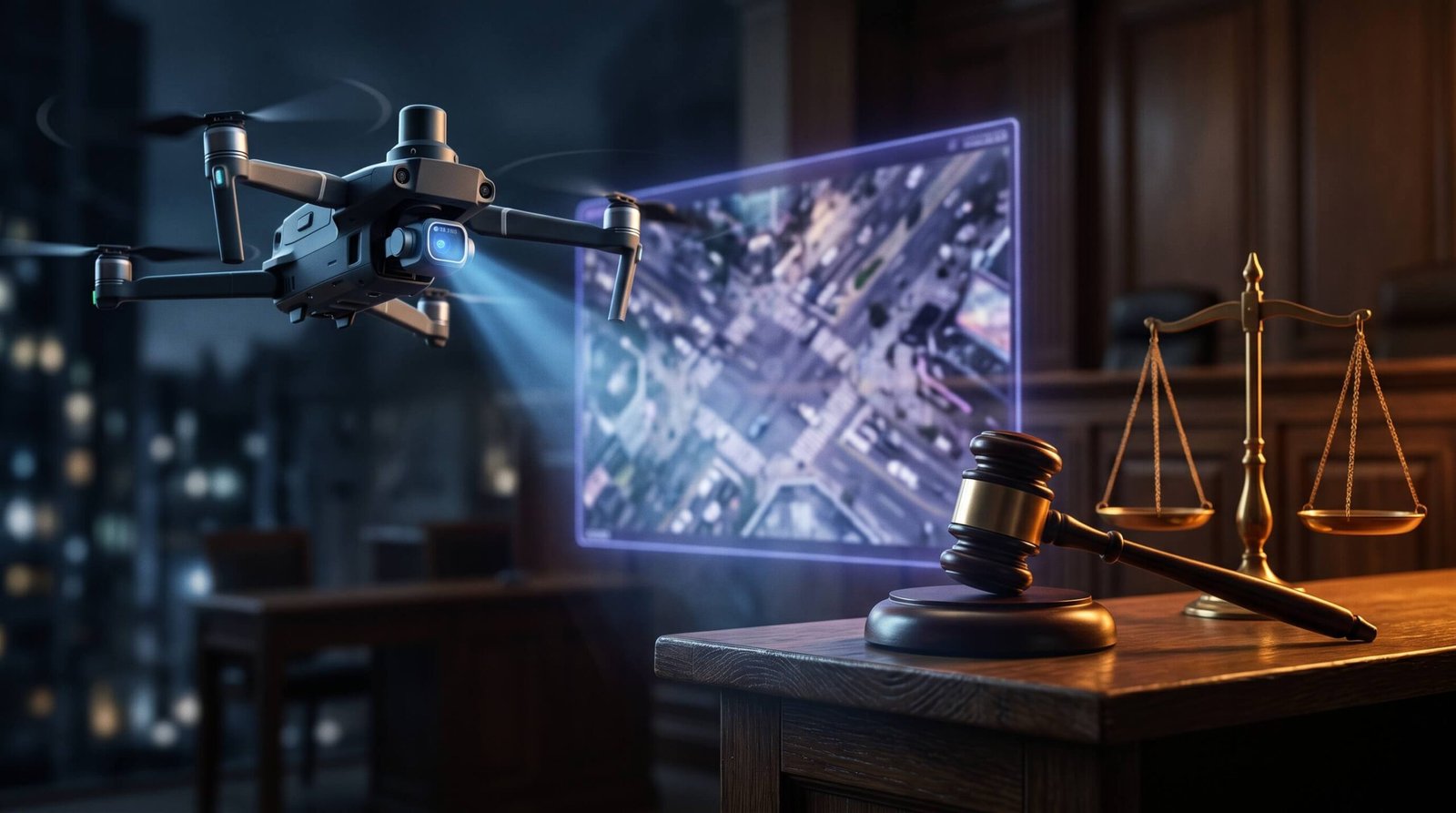
This question actually splits into two separate legal issues that get confused constantly. The first is whether the drone flight itself was legal in the first place. The second is whether the resulting footage meets the normal rules for evidence once it’s in front of a judge. Get the first one wrong, and it usually doesn’t matter how good the footage looks — it gets thrown out anyway.
Question One: Was Flying the Drone Legal?
The Supreme Court has never ruled directly on drone surveillance, so courts are still applying older aerial-surveillance cases by analogy — and those older cases point in a fairly permissive direction. In California v. Ciraolo (1986), the Court held that police didn’t need a warrant to observe a fenced backyard from a fixed-wing plane at 1,000 feet, since anyone flying overhead in public airspace could see the same thing. Florida v. Riley (1989) extended that same logic to a helicopter hovering at 400 feet over a partially open greenhouse.
But a separate line of cases complicates that picture. In Kyllo v. United States (2001), the Court ruled that using a thermal imaging device to see inside a home was a search requiring a warrant, because the technology could reveal details “that would previously have been unknowable without physical intrusion.” A drone equipped with thermal cameras or wall-penetrating sensors runs squarely into this rule. And in Carpenter v. United States (2018), the Court found that long-term, detailed government tracking of someone’s location can violate a reasonable expectation of privacy — even when the underlying information is technically accessible.
Some courts have started blending that reasoning specifically for drones. In Long Lake Township v. Maxon, a Michigan appeals court rejected the idea that older aircraft cases should automatically apply to drones, reasoning that drones can fly lower, hover longer, and capture far more detail than a plane ever could. The court concluded that people generally do retain a reasonable expectation of privacy against drone surveillance, meaning police need a warrant or a recognized exception.
The State-by-State Patchwork
Because the Supreme Court hasn’t settled this, more than 20 states have passed their own drone surveillance laws — and they don’t agree with each other:
| State Example | Approach |
|---|---|
| Florida | One of the strictest: presumes a reasonable expectation of privacy even for things visible from the air; requires a warrant with narrow exceptions (like monitoring a crowd of 50+ people); footage collected illegally is inadmissible, including anything discovered because of it |
| Michigan | Courts have ruled, through case law rather than statute, that drone surveillance of private property generally requires a warrant |
| Missouri | Has no enacted statute requiring a warrant for police drone surveillance at all — a bill to create one has been introduced repeatedly since 2013 and never passed, despite frequent claims online that it has |
| Many other states | Fall somewhere in between, often restricting specific capabilities (like facial recognition or long-duration tracking) rather than banning drone flights outright |
If your agency operates near a state border, this matters in a very literal way — a flight pattern that’s perfectly legal on one side of a state line can require a warrant a few miles away on the other side.
Question Two: Is the Footage Itself Admissible?
Assuming the flight itself was lawful, drone footage gets treated like any other video evidence under the Federal Rules of Evidence. The party offering it needs to show enough for a reasonable jury to find it’s authentic — generally through pilot testimony about how and when it was captured, an unbroken chain of custody, and preserved metadata.
Drone footage actually has a built-in advantage here compared to some other video sources: most drones automatically log telemetry data alongside the video itself, including GPS coordinates, altitude, and timestamps. That data can help establish exactly where and when footage was captured, which strengthens authentication and makes it harder to argue the footage was staged or misattributed.
Where the Two Questions Collide
Here’s the part that trips up a lot of drone programs: even flawless footage, perfectly authenticated, gets thrown out if the flight that captured it violated the Fourth Amendment or a state drone statute in the first place. This is the “fruit of the poisonous tree” doctrine — evidence obtained through an illegal search doesn’t become usable just because it was recorded cleanly. In states with strict drone statutes like Florida’s, this isn’t just a Fourth Amendment argument either; the statute itself can independently declare the footage inadmissible, along with anything else investigators found as a result of it.
What This Has Cost in Practice
Sonoma County, California offers a real look at what can go wrong. Since adopting a drone policy in 2019, the county’s program conducted more than 700 surveillance flights, captured roughly 5,600 images of private property, and flew as low as 100 feet above ground in some cases. That program is now facing federal litigation, with reported financial exposure in the millions, over whether it operated with adequate warrant protocols. It’s become something of a cautionary case study for other municipalities building out their own drone programs without first locking down clear legal guardrails.
The Practical Bottom Line
Drone footage can absolutely be used as evidence — plenty of it is, every day, from accident reconstructions to search-and-rescue documentation. But “can police use a drone” and “can they use whatever they capture with it” are two different questions with two different answers. The first depends heavily on where the flight happened, what technology the drone was carrying, and what your state’s specific law says. The second depends on ordinary evidence rules that apply once you clear that first hurdle. Skip the first question, and the second one never even gets asked — because the footage won’t make it into the courtroom at all.