Police Drones Replacing Car Chases

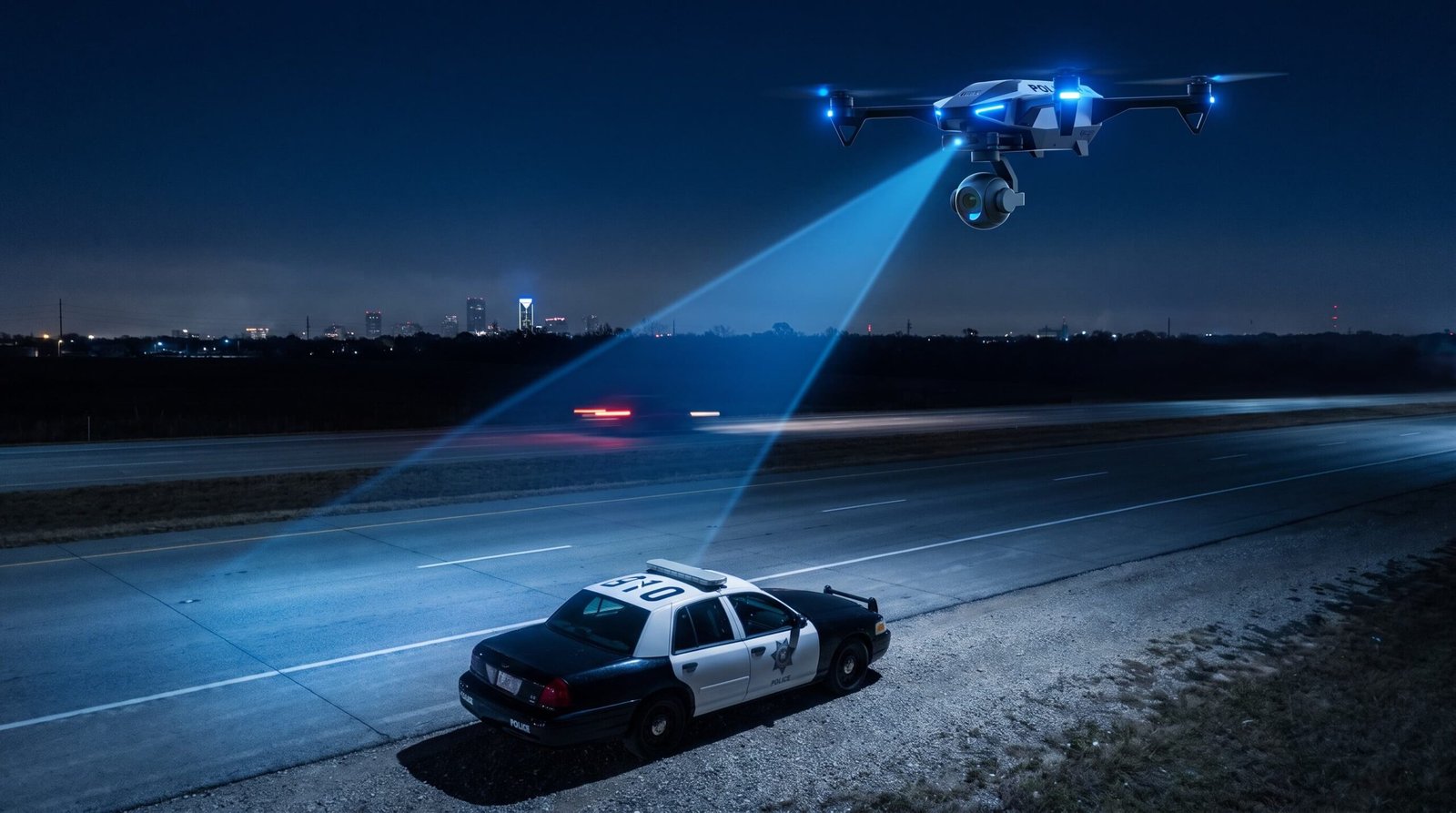
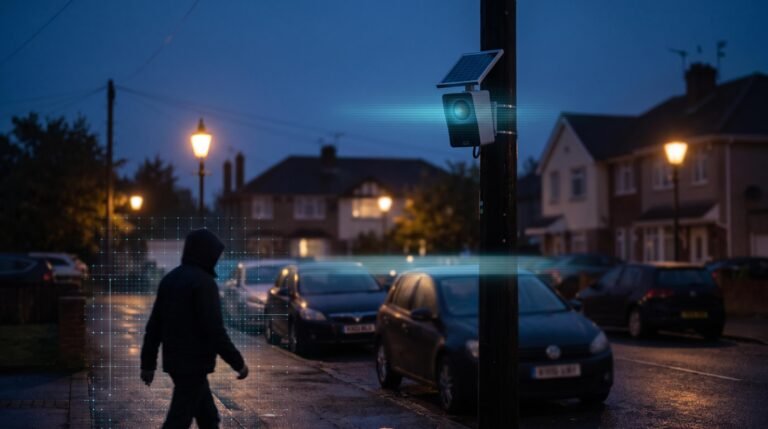
A driver blows through a stop sign, spots a patrol car, and guns it — expecting the usual: lights, sirens, a chase. Instead, the patrol car hangs back. Overhead, a drone that launched before the officer even left the parking lot is already tracking the vehicle from a few hundred feet up, quietly relaying its location, speed, and direction turn by turn. No pursuit. No risk to anyone on the road. Just a set of eyes that never has to slow down, speed up, or run a red light to keep watching.
This isn’t a hypothetical. It’s becoming standard practice in a growing number of U.S. police departments, and it’s reshaping one of the most dangerous routine situations in policing: the car chase.
What “Drone as First Responder” Actually Means
The programs behind this shift are usually called Drone as First Responder, or DFR. Instead of an officer carrying a drone in their trunk and launching it once they arrive at a scene, DFR programs pre-position drones on rooftop docking stations around a city. When a 911 call comes in, the nearest drone can launch immediately — often before a single patrol car has even been assigned — and reach the location well ahead of any officer on the ground.
A remote pilot, usually working out of a real-time crime center, steers the drone and streams live video back to dispatchers and responding officers. For situations like a fleeing vehicle, that live feed becomes an alternative to a ground pursuit altogether.
Where This Started
Chula Vista, California launched the country’s first DFR program back in 2018, and it’s still treated as the model other cities study before building their own. The department has kept its average drone response time down to around two and a half minutes, and roughly a quarter of its calls get resolved with a drone alone — no patrol car ever needs to be sent.
That track record is a big part of why the idea spread. According to the Electronic Frontier Foundation, roughly 1,500 U.S. police departments now run some version of a drone program, and DFR specifically has been adopted by cities from Queen Creek, Arizona to Yonkers, New York to Fairfax County, Virginia over just the past couple of years.
Why Departments Are Choosing Drones Over Pursuits
High-speed chases have always carried a brutal trade-off: catching a fleeing suspect versus the real risk of a crash that injures or kills someone who had nothing to do with the original offense — a bystander, a passenger, or the officer. That risk is exactly why most department policies already restrict when officers are allowed to pursue a vehicle at all, especially for minor offenses.
A drone changes the math. It can follow a moving vehicle from the air at a safe distance, keep transmitting its location in real time, and never has to worry about running lights, oncoming traffic, or pedestrians. Officers on the ground can hang back, follow at a normal speed, and let the vehicle either run out of road, run out of gas, or simply stop — all while dispatchers and other units already know exactly where it is.
Some departments have started treating this as standard procedure for exactly this kind of scenario: a driver who refuses to stop gets tracked from above instead of chased on the ground, removing much of the incentive for the driver to keep escalating.
What Changed on the Ground
- Officers can disengage from a pursuit without losing track of the vehicle
- Dispatch has a live, continuously updating location instead of relying on radio updates from a chasing unit
- The drone can often reach and follow a moving vehicle faster than a patrol car can catch up to one
- Departments can document the entire event on video, which helps both with prosecutions and with reviewing an officer’s decision-making afterward
- The public safety risk shifts from a high-speed chase to a quiet aerial follow
The Guardrails Departments Say They’re Building In
Because this technology could easily be used for more than emergency response, several cities have written specific limits into their drone policies. Yonkers, New York’s program, for example, restricts drones to active calls for service only — not general patrol or overwatch — and requires the camera to face the horizon, not the streets below, whenever a drone is simply flying back to its dock. Recording anywhere someone would reasonably expect privacy, like inside a home, generally requires a warrant or a genuine emergency under these policies.
Whether every department actually follows through on guardrails like these is a separate question, and it’s one civil liberties groups are watching closely.
The Trade-Offs Nobody’s Fully Settled
Not everyone is comfortable with how fast this technology is spreading. The same live-tracking capability that lets a drone replace a dangerous car chase also means cities are building out a permanent aerial surveillance layer — and unlike a chase, which ends, a drone network doesn’t necessarily stop watching once one call is resolved. Civil liberties groups have raised concerns about mission creep: once a city has drones capable of tracking any vehicle in real time, what stops that capability from being used more broadly over time?
There’s also a hardware question in the background. Several departments, including El Paso’s, have been working to replace Chinese-manufactured drones after a federal ban on new purchases of foreign-made drones over national security concerns — adding cost and logistics to programs that were already expensive to build out in the first place.
Where This Is Headed
For now, the safety argument is winning out in city after city — fewer high-speed chases generally means fewer injuries and deaths tied to them, and that’s hard for most local governments to argue against. But as more departments treat a drone overhead as the default response to a fleeing car, the conversation is likely to shift from “does this work” to “how much aerial tracking capability should any single police department have” — a question that’s only going to get more pointed as these programs keep expanding.